 *
Every hesitation is information — not failure.— from the book, "7 Steps to Design Your Life"
You don't need more discipline. You need a life that fits.
no 5am routine requiredStraight from the book — the same process good products go through, walked through your own life instead. Curious why it works? Read the thinking behind it →
Before you change anything, just look — the way a researcher looks at data, without judging it first.
Discovery without definition is like gathering ingredients without ever cooking the meal.
↳ the step most people skipOpen things back up. Guided not by certainty, but by curiosity and a bit of structure.
An idea stops living only in your head the moment you try a small, quick, imperfect version of it.
↳ smaller than you thinkEvery hesitation, every "ugh, not this again" is information — not proof that you've failed.
A life feels right when it resonates on an emotional level — not only when it looks right on paper.
↳ the part spreadsheets missEvery small change supports the next, until it stops being an "effort" and just becomes how you live.
*
Every hesitation is information — not failure.— from the book, "7 Steps to Design Your Life"
A short, honest field guide — not a 300-page workbook you'll never finish.
You don't have to flip your whole life upside down to know if something works. Just try a smaller, safer version of it first.
Each chapter takes one part of that process and gives you the smallest version you can actually try this week — no overhaul, no burnout.
 stéphanie krouthén
I spent years figuring out why strangers get stuck using an app. Then I turned that same question on myself.
Goals, routines, ambition — on paper it all worked. In real life, I still felt stuck, doing everything "right" and hitting the same wall I couldn't quite name.
So I did what I do for a living: stopped guessing and started actually watching. What I found wasn't a discipline problem — it was a design problem. NUYA is that discovery, written down so you can use it too.
Get the free NUYA starter kit — a simple one-pager to help you spot what's quietly running your week — and be the first to know when the book is available.
You're one click from your starter kit — check your inbox to confirm. No spam, ever.
Last updated: September 2026.
If you sign up for the NUYA starter kit, we collect your first name, last name and email address, submitted via the form on this page and processed by Netlify, Inc. (our hosting provider) purely to deliver the submission to us by email.
To send you the starter kit and occasional updates about NUYA and the book. We never sell or share your email with third parties.
With your consent, we use privacy-friendly analytics to see which pages are useful — no cross-site tracking, no ad profiles. You can decline this and still use the site normally.
You can ask to see, correct or delete your data at any time by emailing stephanie.krouthen@gmail.com. Every email from us includes an unsubscribe option.
This is a starting template, not legal advice — have it reviewed before launch, especially for GDPR/Swiss nDSG compliance.Last updated: September 2026.
NUYA and its content — text, design, the "7 Steps to Design Your Life" method — belong to Stéphanie Krouthén. You're welcome to read, share and link to it; please don't reproduce or resell it without permission.
NUYA's content is for general guidance and self-reflection. It isn't therapy, medical, financial or legal advice — please consult a qualified professional for those.
Release dates and availability are subject to change; we'll keep the mailing list updated with the latest information.
This is a starting template, not legal advice — have it reviewed before launch.Design starts with a decision to pay attention.
In UX, that decision has a shape. Before a designer draws a single screen, they move through a process: understanding a problem, then defining it, then exploring solutions, then building and testing them. The UK Design Council mapped this rhythm in 2004 and called it the Double Diamond — two diamonds side by side, each one opening wide to explore and narrowing to decide.
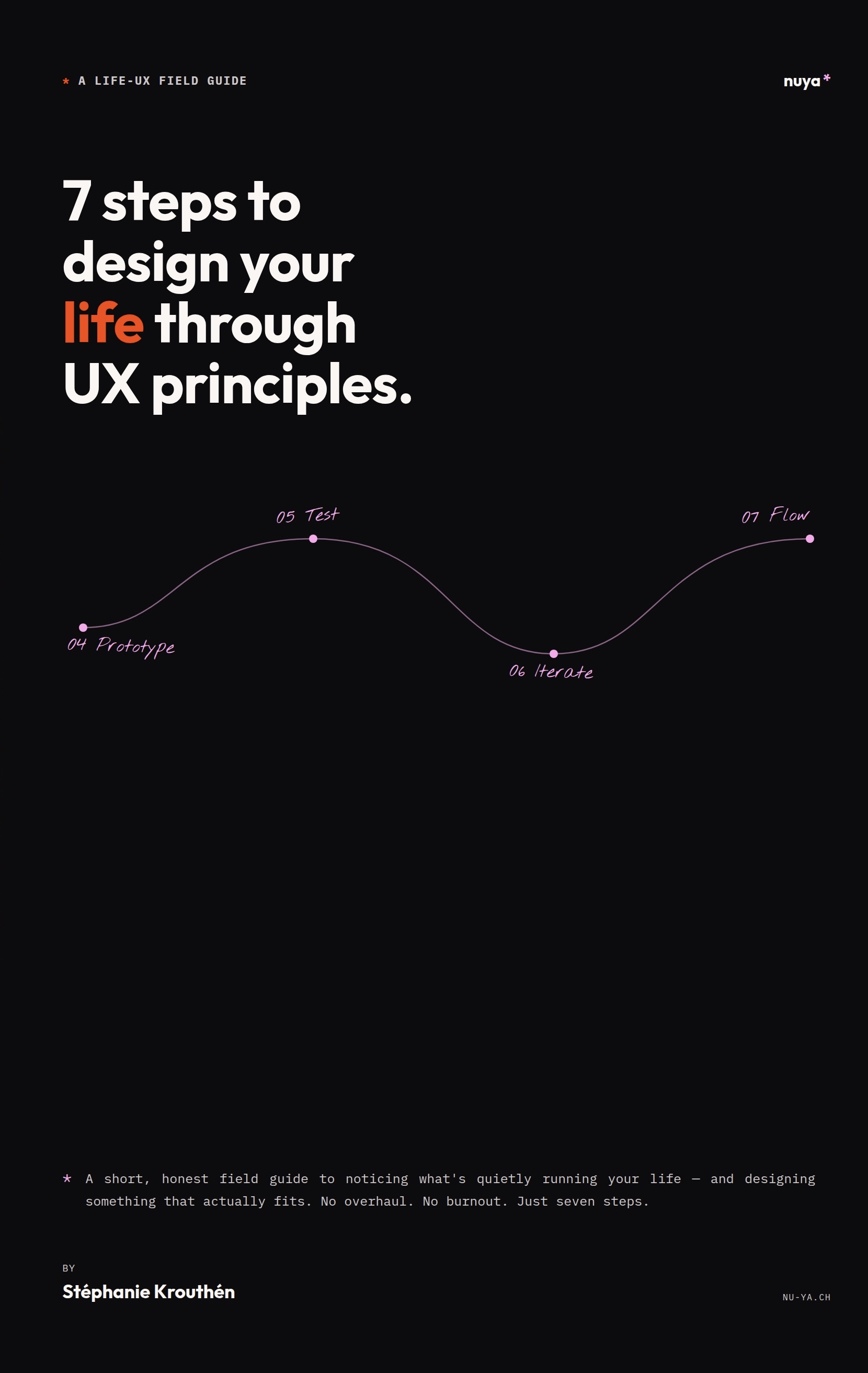
This book borrows that shape for its first five chapters — Discover, Define, Ideate, Prototype, Test — because it is, genuinely, one of the clearest tools I know for turning confusion into a plan. But the Double Diamond closes at Test. It was built for shipping a product, not for living a life. So this book keeps going for two more chapters, Iterate and Flow, because a life doesn't get "delivered" once and left alone — it has to be run, day after day, the way a live event has to be run once the doors open.
I spent years designing digital interfaces before I spent years producing festivals, sponsorship activations, and brand experiences in the live events industry. But if I'm honest about why this book exists, it isn't really about either career. It's about a pattern I only recognized after living inside it for most of my twenties: I am extremely good at planning — and then, right around the point where it would have to become real, quietly starting the next idea instead.
What eventually got me unstuck wasn't a better framework. It was realizing I didn't have to pick one right path and commit to it forever before I was allowed to start. I could test a version of myself the way a designer tests a prototype — small, honest, reversible — and let the result tell me something true.
That is the lens this book asks you to turn on your own life: not self-improvement, but design. Not "fix yourself," but understand the system you're already running, and change the parts that no longer serve it.
Awareness is the first design step.
Every good design process starts with humility: before a designer touches a solution, they admit they don't yet know the problem. So they go looking. They watch how people actually behave, not how they say they behave — those two things are reliably different. They sit next to someone using a product and notice where a hand hesitates, where a brow tightens, where a sigh escapes without the person even registering it. None of that is about finding fault. It's about finding what's true.
This chapter asks you to turn that same attention on yourself. Not to fix anything yet — just to look.